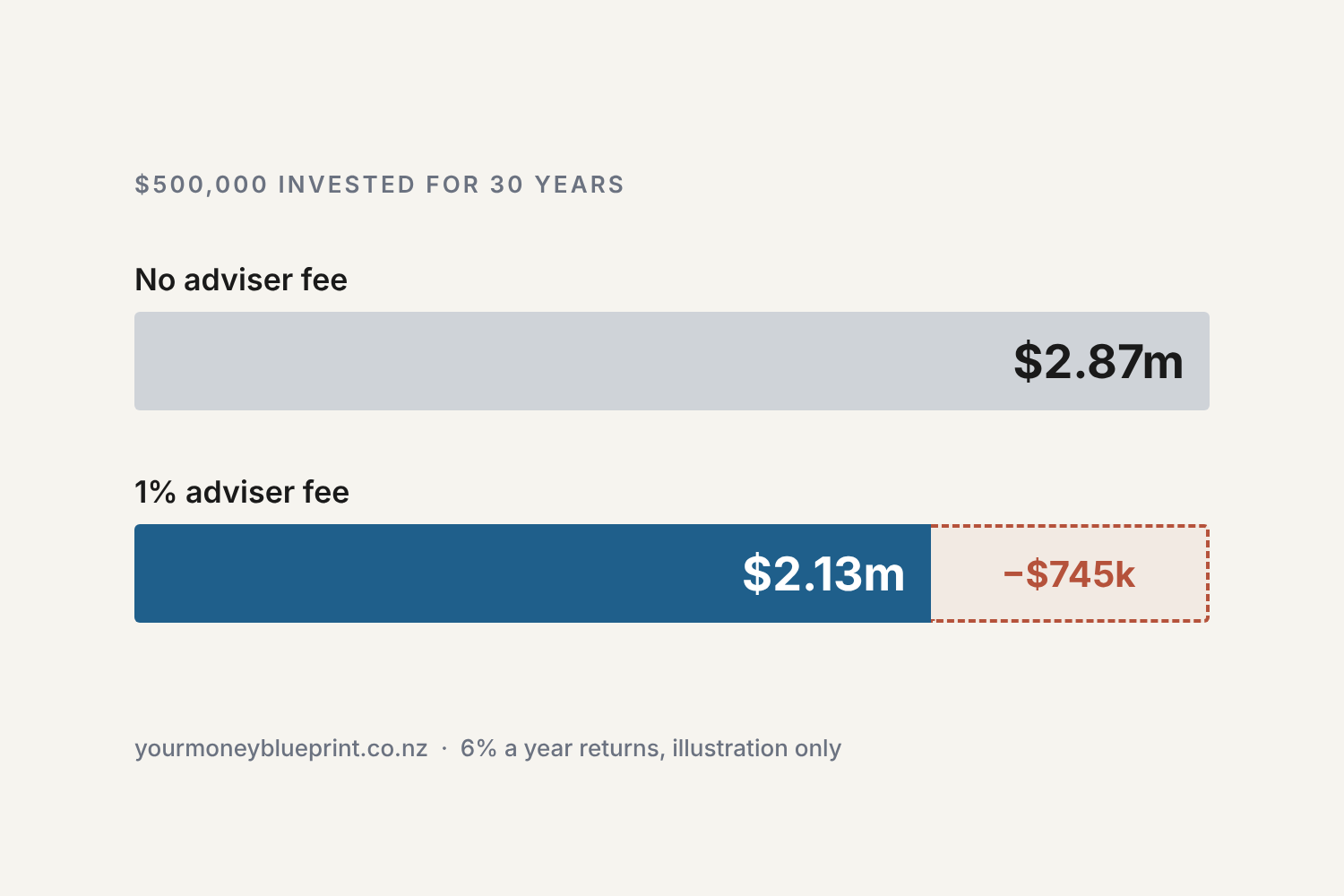
A lot of advisers charge a percentage of your savings every year, and because it comes straight out of your balance, most people never see it leave. I’ve run the numbers across different fee levels, amounts and time frames. At 1% a year, $500,000 ends up $745,000 smaller after 30 years […..]
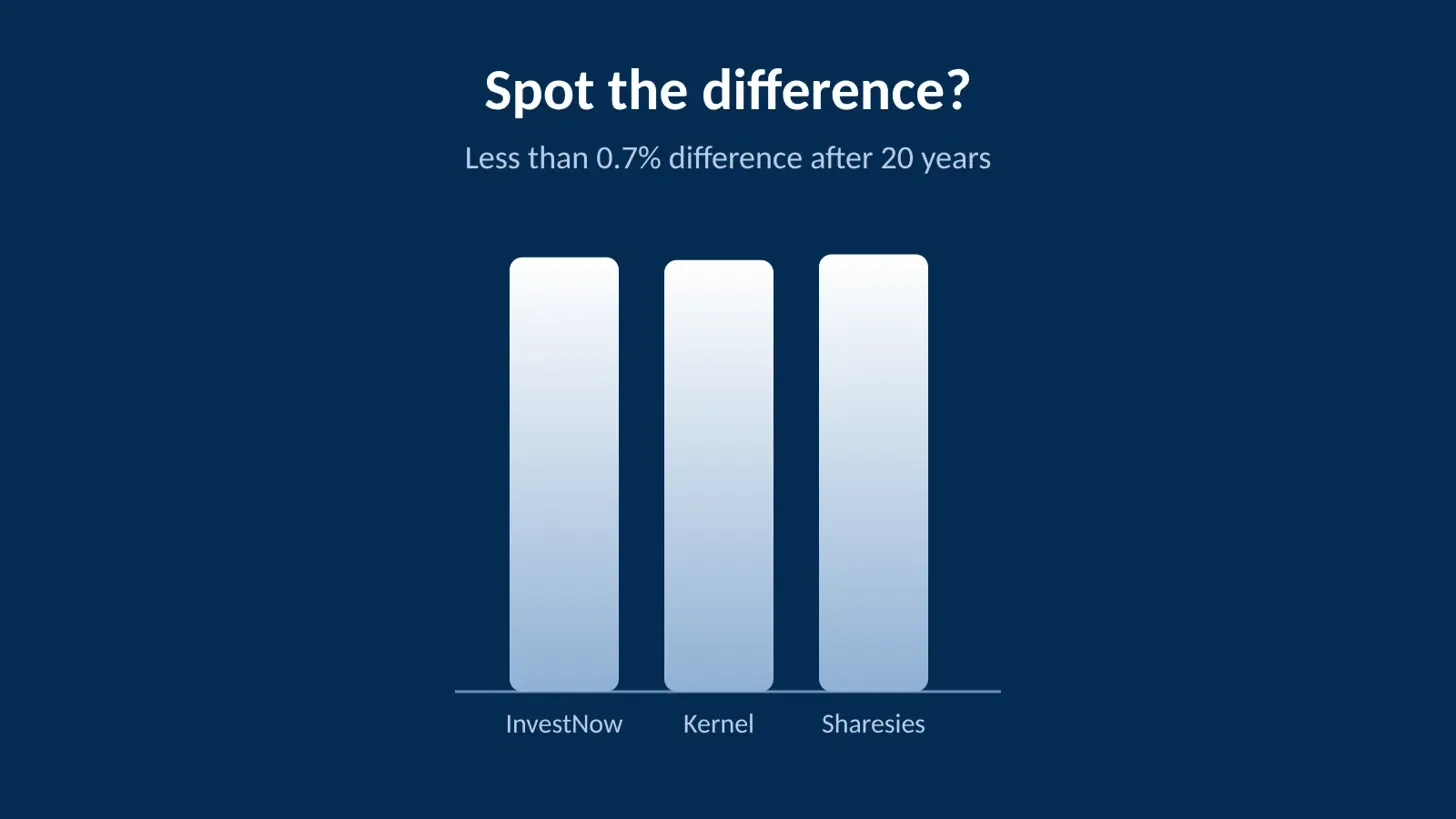
Sharesies vs Kernel vs InvestNow: does the cheapest world fund really matter?
With Sharesies and Kernel both recently launching keenly priced world share funds, the debate over the lowest-cost world share fund available in PIE format has been reignited.
I've seen people on social media making themselves dizzy going back and forth trying to decide which option is best. At the end of the day, the difference is minimal.
The short answer: across three 20-year scenarios, the gap between the best and worst of these funds is […..]
Low cost index investing under fire: what the criticisms get right, and where they fall apart
In the past week, two people employed by New Zealand active fund managers have published pieces arguing that the SPIVA scorecard (the research S&P Dow Jones Indices has produced since 2002 comparing active funds against market indices) makes active management look worse than it is. You can find the Aurellan article here and the NZ Herald article here.
They are not entirely wrong. That's worth saying clearly before I say anything else, because parts of both arguments are good and the passive case doesn't need to pretend otherwise […..]
Investors who stayed the course in 2025 were handsomely rewarded
Another year done and dusted, and another year full of financial commentary and dire predictions.
In the first part of the year all the talk was around Trump’s tariffs. The common consensus was it would crush companies, consumers, and the share market in general. The common consensus was for a recession. Then mid year the Israel-Iran war got going, leading to further calls of an economic recession.
All the […..]
Don't let InvestNow Foundation Series buy and sell fees put you off
Sharesies pricing structure still doesn't benefit the everyday investor
Sharesies did a PR piece recently stating that their investment platform now has more than 1,500 portfolios with over $1 million invested per portfolio.
To the untrained eye it may appear that Sharesies customers are doing really well and have a lot invested. But right off the bat I can see that 1,500 customers with over $1 million invested each only […..]
Why market timing doesn't work
After tax difference in returns using FDR tax vs FDR and CV alternating
Today we are delving deeper into the international non PIE funds. Because it is possible to alternate the method of calculating tax between FDR and CV method. This flexibility provides great benefit to the international investor during years where returns are less than 5%.
We are going to explore if that is enough benefit to close the gap between PIE and non PIE funds […..]
After tax difference in returns between an international PIE fund and a non PIE (FIF) fund)
Today I thought I would run another comparison to see how much of a head start one form of investing provides over another. Investing in an international PIE fund vs investing in an international non PIE (FIF) fund.
Using the same 21 period of returns from January 2004 to January 2025, the US500 produced annualised returns (including dividends) of 10.38%.
Below are the 21 year results of the after tax returns at different tax rates for both a PIE fund and a non PIE fund […..]
Why do fund companies have such a high allocation towards NZ shares?
Are Kernel or Sharesies or Hatch ETF fees best?
Which Sharesies pricing plan is best for me?
So you’ve decided you want to invest in ETF’s or shares, and are interested in using Sharesies. But then you get presented with four pricing plans. It is a bit of a challenge to calculate how much you will pay in transaction fees when you are originally investing in New Zealand dollars, charged in international dollars, and paying fees in New Zealand dollars.
Thankfully I have done the automation for you […..]
Chase higher investment returns or save more?
Investing using the bucket strategy
Higher interest rates don't necessarily make cash a good option
Cash is so hot right now.
Everyone seems to piling their savings into cash like products. Savings accounts, term deposits, and so on.
Just look at the data from the Reserve Bank.
The amount of money in cash is […..]