
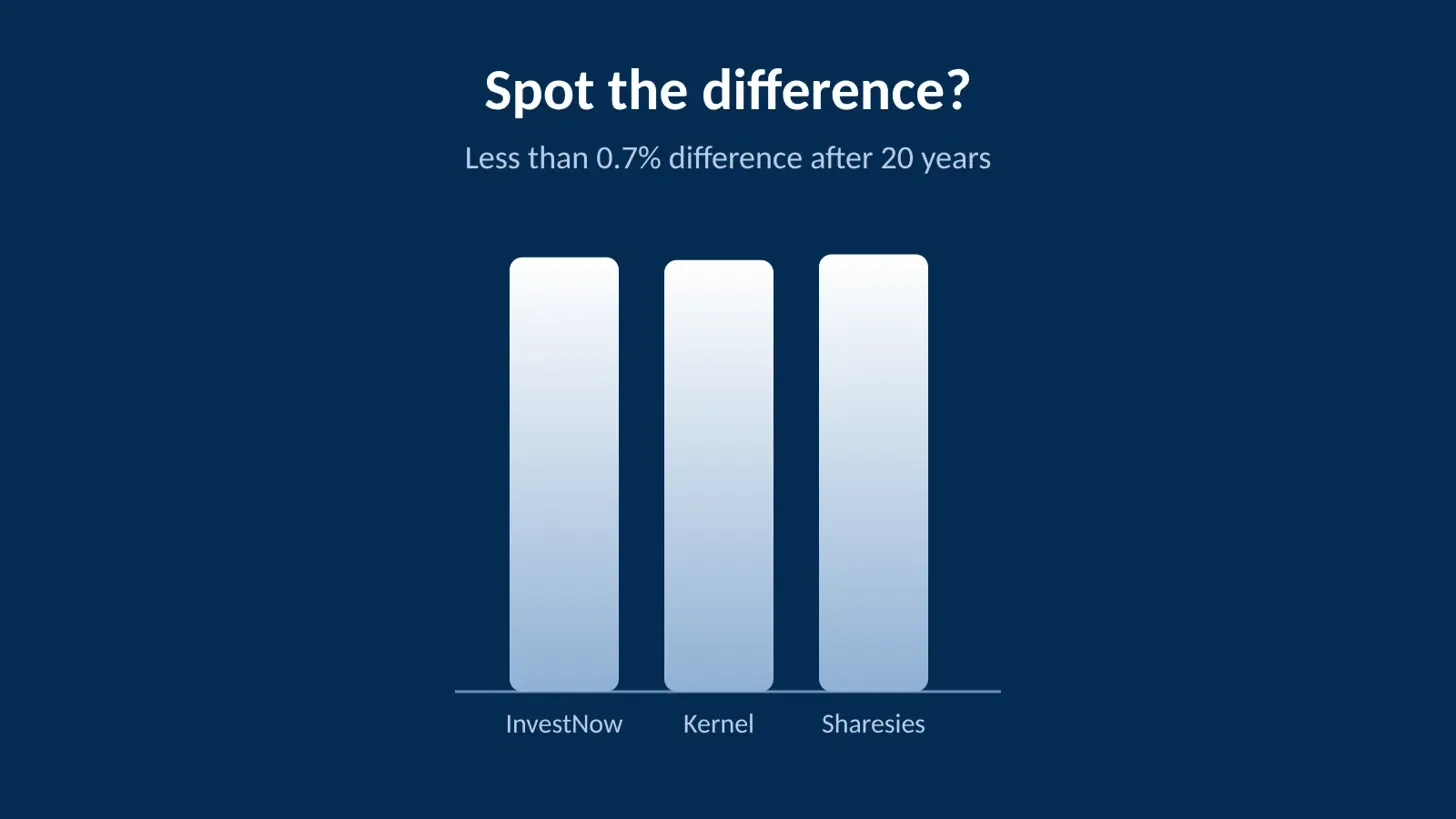
With Sharesies and Kernel both recently launching keenly priced world share funds, the debate over the lowest-cost world share fund available in PIE format has been reignited.
I've seen people on social media making themselves dizzy going back and forth trying to decide which option is best. At the end of the day, the difference is minimal.
The short answer: across three 20-year scenarios, the gap between the best and worst of these funds is less than 0.7% of your final balance (not to be confused with a 0.7% fee difference). That is a few dollars a month.
Optimise, but don't obsess
I get it. It's always nice to optimise your finances, but not if it's taking up your day's brain space. I want my free time spent being creative, relaxing, spending time with family or doing things I love. Of course I enjoy running the numbers, but numbers aren't my life! I want my finances sorted so I can live the rest of my life with as few financial worries as possible. I don't understand the need to spend hours of mental bandwidth trying to squeeze out every last dollar. Live your lives, people!
Let's look at a few examples.
The three contenders
Here is how the three world share funds compare on fees (as at October 2026):
• Sharesies Global Shares Fund: 0.10% a year, no transaction fees and no subscription needed.
• Kernel Total World Fund: 0.12% a year and no transaction fees, but you need a Kernel Plus or Premium subscription to invest in it. My numbers assume the plus (cheaper) subscription of $5 per month.
• InvestNow Foundation Series Total World Fund: 0.06% a year, plus a 0.50% transaction fee each time you buy or sell. Available in both hedged and unhedged versions.
That transaction fee is why InvestNow starts behind and slowly catches up. You pay it on the way in, while its lower ongoing fee chips away at the gap every year.
Running the numbers
You can run your own numbers using the investment fund provider comparison calculator on the calculators page of my website, or the Fund Fight calculator in the Your Money Blueprint app.
All three examples assume an 8% a year gross return over 20 years.
Example 1: A one-off $200,000 investment
First, let's look at a one-off investment of $200,000 over 20 years, assuming an 8% a year gross return.
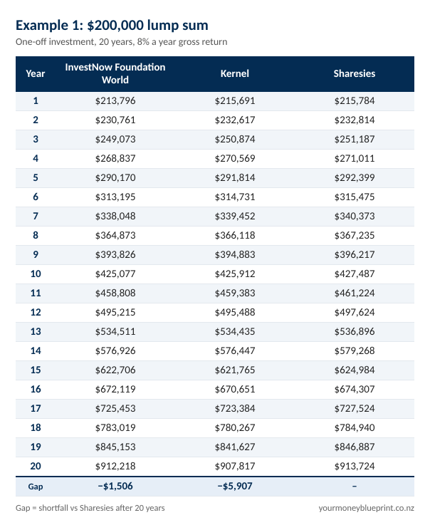
Sharesies and Kernel are ahead early on. Sharesies slightly extends its lead over Kernel over time, while InvestNow gradually closes the gap.
After 20 years, Sharesies is around $1,500 ahead of InvestNow and around $6,000 ahead of Kernel. That works out to about $6 a month extra from Sharesies over InvestNow, and $25 a month between Sharesies and Kernel. It is even less once you factor in inflation.
InvestNow actually pulls ahead around year 25 in this example, and at around the same time for many other one-off investment amounts.
Example 2: $1,000 a month, starting from nothing
Now let's look at someone who invests monthly but has nothing to start with. We'll assume $1,000 a month for 20 years.
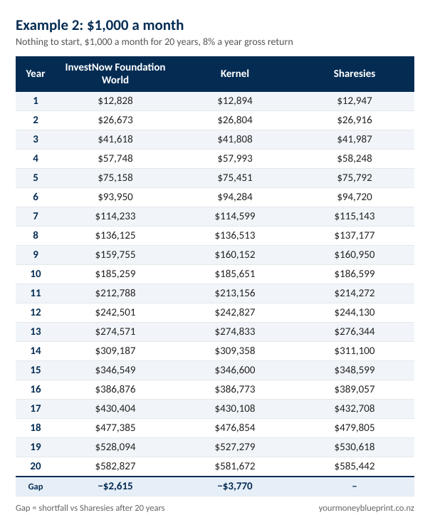
Kernel stays a lot closer to InvestNow for longer in this example, and the gap between Kernel and Sharesies is similar in percentage terms. InvestNow doesn’t overtake Sharesies until year 32, an extra seven years compared with the lump sum.
After 20 years, though, the difference is only around $11 a month between Sharesies and InvestNow, and $16 a month between Sharesies and Kernel.
Example 3: The hybrid investor, $200,000 plus $1,000 a month
Finally, the hybrid investor, who has a lump sum and can also invest regularly. Let's say $200,000 to invest up front plus $1,000 a month for 20 years.
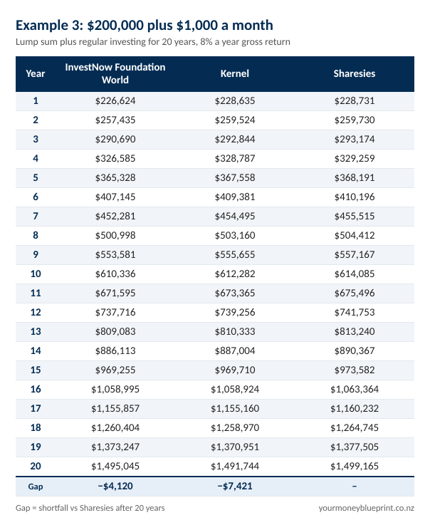
The results are pretty similar to the first, lump sum only scenario. But Sharesies is slightly further ahead of InvestNow, because of the regular monthly additions into the InvestNow fund (each one pays the buy fee). It now takes 27 years for the InvestNow fund to overtake the Sharesies one.
So how big is the difference, really?
Across all three 20-year scenarios:
• Sharesies vs Kernel: between $16 and $31 a month
• Sharesies vs InvestNow: between $6 and $17 a month
• Best vs worst: less than a 0.7% difference in total wealth in every scenario
Paralysis by analysis costs more than fees
I've even seen people deliberating over which fund to buy come back six months later with the same question. Imagine having paralysis by analysis for six months! Not only have you been out of the market, but the mental bandwidth it's taking up isn't good for you.
If you delay investing by one year, then invest double in the second year once you've decided (so your total contributions are the same), that alone is enough for the Sharesies fund to lose its fee advantage.
Your spending matters more than your fund's fee
Or say an investor has no trouble choosing Sharesies, knowing it's the best fund for them after many hours of analysis, but they're frivolous with their spending. I see this all the time: people who are deep analytical thinkers when it comes to finding the best fund, taking many hours to deliberate, yet whose own spending has leaks aplenty.
In the first example, just $3 a month of extra spending is enough to wipe out the Sharesies advantage over InvestNow! It is $5 a month in the second example and $8 a month in the third.
I don't get this obsession with optimising investment fees while at the same time disregarding your household spending. If people spent as much time looking inward at their own finances as they do looking outward comparing similarly priced funds, it would make a far greater impact. Imagine, $10 less spend per month has greater impact than choosing the most optimal low fee fund.
But I get it. It's much easier to look outside ourselves. No one likes to feel challenged or scrutinised, even when we're the ones doing it.
Fees aren't the whole story
Fees are just one part of the decision. There are two other things I'd weigh up.
1. Hedged and unhedged options
One area where InvestNow currently holds the edge is that it offers both hedged and unhedged versions of its world share fund. Sharesies and Kernel only offer unhedged versions right now, although Sharesies lists a hedged version as coming soon.
That isn't a deal breaker for many people, but it is for me. I like to split world share holdings, both my own and my clients', between hedged and unhedged. You can't currently do that with Sharesies or Kernel. The reason for the split is twofold.
It spreads the risk. If one version performs better or worse, you're only exposed to half. You'll always own both the better-performing half and the worse-performing half, which in my opinion beats owning only the worse one. Sure, you could be giving up owning only the better one, but that's really a coin flip, and not a bet I'm willing to make.
It gives you flexibility when you sell. Just as bonds and cash give you options when deciding whether to sell shares or bonds, holding both hedged and unhedged gives you options when you need to sell shares. You can decide how much of each to sell based on how they've performed, selling whichever has done best. That not only helps you rebalance, it also stretches your money further than it would otherwise.
2. A platform that encourages tinkering
The second point relates to Sharesies: its platform encourages trading and making lots of decisions. Over time I've realised that all an investor needs is a handful of funds and trust in the process. The more funds you hold and the more buy and sell decisions you make, the worse off you will tend to be.
Sharesies encourages that kind of tinkering. Its app encourages frequent check-ins: the push notifications, the options, the colours, the emails, the online forums. They all provide dopamine to a sugar-craving investor. Someone who goes to Sharesies for the world share fund may find themselves lured into too many temptations, undoing all their good work in finding a low-cost world fund by investing in higher-cost alternatives too.
InvestNow, to many people's displeasure, has very ordinary reporting. I see that as a good thing. The more inactive an investor is, the better.
The bottom line
All three are excellent low-cost options, and the fee differences between them come to a few dollars a month. Pick the one that suits how you invest, set up your regular contributions, and get on with living. Your spending, your savings rate and your ability to leave things alone will matter far more than a few hundredths of a percent in fees.
If you'd like help with the bigger picture, get in touch.
The information contained on this site is the opinion of the individual author(s) based on their personal opinions, observation, research, and years of experience. The information offered by this website is general education only and is not meant to be taken as individualised financial advice, legal advice, tax advice, or any other kind of advice. You can read more of my disclaimer here