
Full disclosure first
I'm an independent, fee only adviser. I charge a one off fee for a financial plan and I don't take a percentage of anyone's savings. So I've got a horse in this race, and I do better when more people take control of their own money. With that out in the open, the maths is the maths. I've shown every assumption below so you can check it yourself.
A lot of advisers who look after your investments charge what's called an assets under management fee, or AUM fee. It's a percentage of your balance every year, usually somewhere between 0.5% and 1.5%. You don't get an invoice for it. It comes straight out of your portfolio, a little bit at a time, so most people never actually see it leave. Out of sight, out of mind.
I wanted to put some real numbers on it across a whole range of situations. Different fee levels, different amounts, different time frames, and whether you invest a lump sum, a regular amount each month, or both.
How a percentage fee works
A percentage fee grows as your balance grows. On $200,000, a 1% fee is $2,000 a year. On $500,000 it's $5,000 a year, and on $1 million it's $10,000 a year. Looking after $1 million usually isn't five times the work of looking after $200,000. The fee is five times bigger anyway.
It also compounds against you. Every dollar that goes out in fees stops earning returns for the rest of the time you're invested. So the real cost is the fees you pay plus all the growth those dollars would have earned if they'd stayed put. Over 20 or 30 years, that lost growth is often bigger than the fees themselves.
Take $500,000 with a 1% fee. In year one the fee is about $5,100. By year 10 it's about $7,900 a year, by year 20 about $12,900 a year, and by year 30 about $20,800 a year. The service doesn't have to change at all for that to happen. Your balance just got bigger.
The assumptions
These are illustrations, not predictions. Real returns bounce around from year to year. Here's what I've used:
Returns of 6% a year, after the funds' own fees and before any adviser fee.
The adviser fee comes out of the balance monthly.
Regular contributions go in monthly.
Tax and inflation are left out to keep it simple. They'd change the dollar amounts but not the overall picture.
The fee levels of 0.5%, 0.75%, 1% and 1.5% are examples only, not any particular firm's pricing. Some advisers also have platform or admin fees on top, which would make the numbers worse.
When I talk about the cost, I mean how much smaller your portfolio ends up compared with the exact same portfolio with no adviser fee. That covers the fees you paid and the growth you missed out on.
If you invest a lump sum
With a lump sum, the percentage you lose is the same whatever you start with. Here's what that looks like in dollars. Each figure is how much less you'd end up with compared with paying no adviser fee.
| Starting amount | Fee | After 10 years | After 20 years | After 30 years |
|---|---|---|---|---|
| $100,000 | 0.5% | $9,000 | $31,000 | $80,000 |
| 0.75% | $13,000 | $45,000 | $116,000 | |
| 1% | $17,000 | $58,000 | $149,000 | |
| 1.5% | $25,000 | $83,000 | $208,000 | |
| $250,000 | 0.5% | $22,000 | $76,000 | $200,000 |
| 0.75% | $32,000 | $112,000 | $289,000 | |
| 1% | $43,000 | $145,000 | $372,000 | |
| 1.5% | $62,000 | $208,000 | $521,000 | |
| $500,000 | 0.5% | $44,000 | $153,000 | $400,000 |
| 0.75% | $65,000 | $223,000 | $579,000 | |
| 1% | $85,000 | $291,000 | $745,000 | |
| 1.5% | $125,000 | $416,000 | $1,041,000 | |
| $1,000,000 | 0.5% | $87,000 | $305,000 | $800,000 |
| 0.75% | $129,000 | $447,000 | $1,158,000 | |
| 1% | $170,000 | $582,000 | $1,489,000 | |
| 1.5% | $250,000 | $832,000 | $2,082,000 |
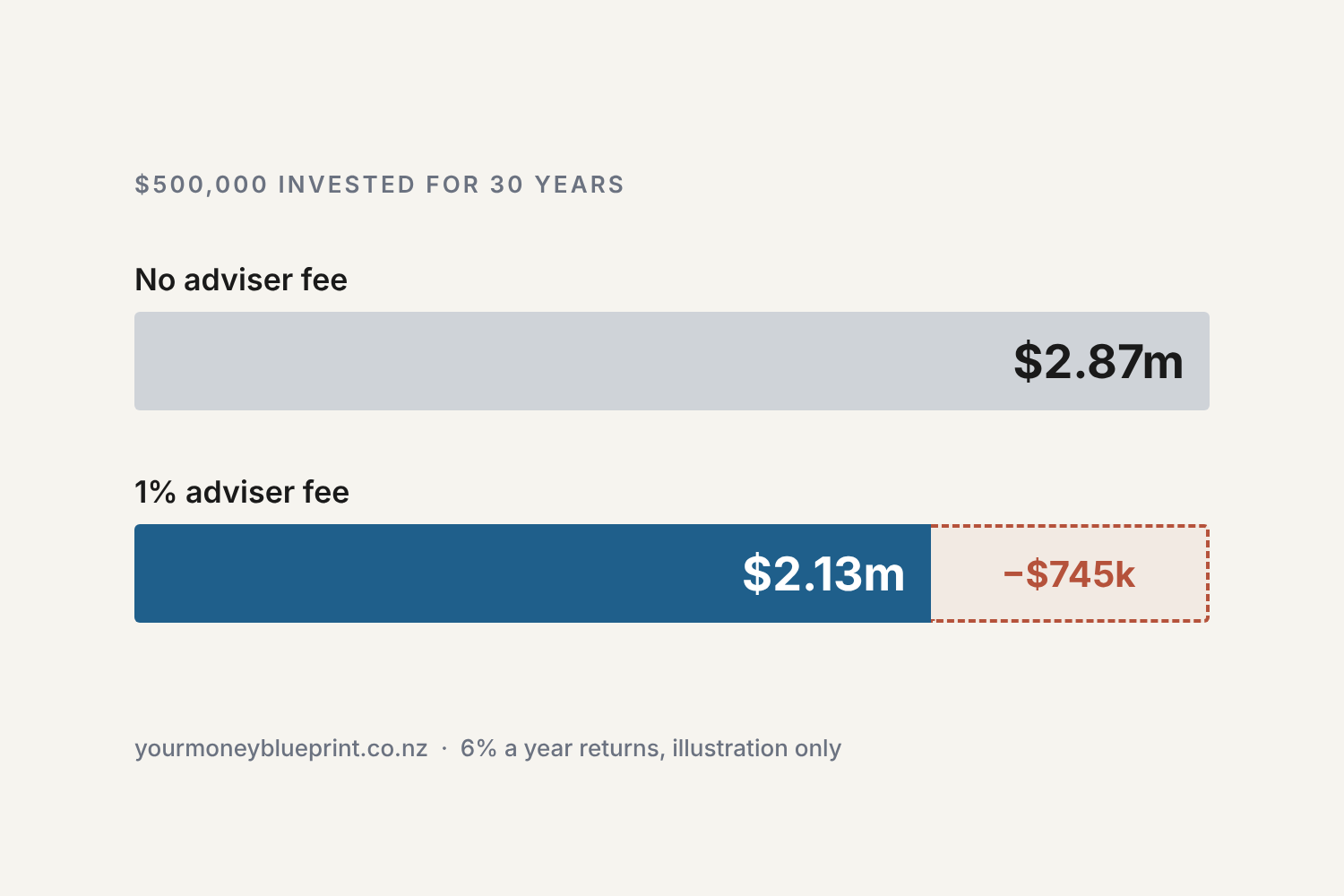
For context, $500,000 with no adviser fee grows to about $895,000 after 10 years, $1.6 million after 20 and $2.87 million after 30. At a 1% fee it ends up $745,000 smaller after 30 years. About $338,000 of that is fees you actually paid. The other $407,000 is growth those fees never got the chance to earn.
If you invest a regular amount each month
Most people build their savings bit by bit, often called dollar cost averaging. The hit is smaller in the early years because your balance starts at zero. Give it time though and it catches up, because the fee is charged on everything you've built up.
Each figure is how much less you'd end up with, and the percentage in brackets is how much smaller your portfolio is.
| Monthly amount | Fee | After 10 years | After 20 years | After 30 years |
|---|---|---|---|---|
| $500 | 0.5% | $2,000 (3%) | $13,000 (6%) | $44,000 (9%) |
| 0.75% | $3,000 (4%) | $19,000 (8%) | $65,000 (13%) | |
| 1% | $4,000 (5%) | $25,000 (11%) | $84,000 (17%) | |
| 1.5% | $6,000 (8%) | $37,000 (16%) | $120,000 (24%) | |
| $1,000 | 0.5% | $4,000 (3%) | $26,000 (6%) | $89,000 (9%) |
| 0.75% | $7,000 (4%) | $39,000 (8%) | $130,000 (13%) | |
| 1% | $9,000 (5%) | $51,000 (11%) | $169,000 (17%) | |
| 1.5% | $13,000 (8%) | $73,000 (16%) | $240,000 (24%) | |
| $2,000 | 0.5% | $9,000 (3%) | $52,000 (6%) | $178,000 (9%) |
| 0.75% | $13,000 (4%) | $77,000 (8%) | $260,000 (13%) | |
| 1% | $17,000 (5%) | $101,000 (11%) | $337,000 (17%) | |
| 1.5% | $26,000 (8%) | $147,000 (16%) | $479,000 (24%) |
Say you put away $1,000 a month for 30 years. That's $360,000 of your own money, and with no adviser fee it grows to about $979,000. At 1% you'd end up $169,000 short of that. About $94,000 of it is fees paid and the rest is lost growth.
A lump sum plus regular top ups
This is probably the most common situation for people who see an adviser. You've built up some savings or had a windfall, and you keep adding to it every month. Same as before, the percentage in brackets is how much smaller your portfolio ends up.
| Starting amount plus monthly | Fee | After 10 years | After 20 years | After 30 years |
|---|---|---|---|---|
| $100,000 + $1,000 | 0.5% | $13,000 (4%) | $57,000 (7%) | $169,000 (11%) |
| 0.75% | $20,000 (6%) | $83,000 (11%) | $246,000 (16%) | |
| 1% | $26,000 (8%) | $109,000 (14%) | $317,000 (20%) | |
| 1.5% | $38,000 (11%) | $157,000 (20%) | $448,000 (29%) | |
| $250,000 + $2,000 | 0.5% | $31,000 (4%) | $129,000 (8%) | $378,000 (11%) |
| 0.75% | $46,000 (6%) | $189,000 (11%) | $549,000 (16%) | |
| 1% | $60,000 (8%) | $247,000 (14%) | $709,000 (21%) | |
| 1.5% | $88,000 (11%) | $355,000 (21%) | $1,000,000 (29%) | |
| $500,000 + $2,000 | 0.5% | $53,000 (4%) | $205,000 (8%) | $578,000 (12%) |
| 0.75% | $78,000 (6%) | $301,000 (12%) | $838,000 (17%) | |
| 1% | $103,000 (8%) | $392,000 (16%) | $1,082,000 (22%) | |
| 1.5% | $151,000 (12%) | $563,000 (22%) | $1,521,000 (31%) |
Take someone starting with $250,000 and adding $2,000 a month. With no adviser fee they'd have about $3.4 million after 30 years. At 1% they'd have $709,000 less, and $356,000 of that is fees they paid along the way. That's a lot of money for something you never see an invoice for.
How quickly a percentage fee overtakes a one-off fee
Here's how long it takes for the total percentage fees paid to pass a one-off fee of $3,700, which is about what a full financial plan costs with me.
| Your situation | 0.5% fee | 0.75% fee | 1% fee | 1.5% fee |
|---|---|---|---|---|
| $100,000 lump sum | 6 yrs 3 mths | 4 yrs 5 mths | 3 yrs 5 mths | 2 yrs 5 mths |
| $250,000 lump sum | 2 yrs 9 mths | 1 yr 11 mths | 1 yr 6 mths | 1 yr |
| $500,000 lump sum | 1 yr 6 mths | 1 yr | 9 mths | 6 mths |
| $1,000,000 lump sum | 9 mths | 6 mths | 5 mths | 3 mths |
| $500 a month from scratch | 13 yrs 9 mths | 11 yrs 7 mths | 10 yrs 2 mths | 8 yrs 6 mths |
| $1,000 a month from scratch | 10 yrs 1 mth | 8 yrs 5 mths | 7 yrs 5 mths | 6 yrs 1 mth |
| $2,000 a month from scratch | 7 yrs 4 mths | 6 yrs 1 mth | 5 yrs 4 mths | 4 yrs 5 mths |
To be fair to the percentage model, if you're just starting out with small regular savings, it can work out cheaper for quite a few years. Once your balance gets into the hundreds of thousands, it flips quickly. At $500,000 or more you've usually paid more in a year than a one-off plan costs, and you keep paying every year after that. In saying that though, a lot of advisers who charge a percentage also have a minimum portfolio size or a minimum yearly fee. So if you’re starting small, you may not be able to get this kind of service at all. If you can, a minimum fee can push the real percentage well above the ones in these tables. A $3,000 minimum on a $150,000 portfolio works out at 2% a year.
A one-off fee (like what I charge) has a lost growth cost too, so I'll count that as well. $3,700 left invested at 6% would grow to about $6,600 after 10 years, $11,900 after 20 and $21,300 after 30. Even if you came back for a few hours of extra advice now and then, it's hard to get anywhere close to the AUM figures in the tables above.
The adviser fee is often just one layer
The tables above only show the adviser fee. In real life it’s often one of three layers. There can be a platform or admin fee on top, and the funds themselves charge fees too. Some advisers use low cost index funds and some use more expensive actively managed funds.
Add the layers up and compare them with what a low cost index fund would cost you on its own. If the difference comes to around 1.5% a year, the 1.5% rows in the tables are roughly your situation. Your statements and fund documents should show what each one costs, so it’s worth digging them out and adding them up.
But won't they make it back with better returns?
This is the usual answer from your adviser of choice. The adviser picks better funds or times the market better, so the fee pays for itself. It can happen. The evidence says it's more unlikely than likely.
There’s now a New Zealand version of S&P’s SPIVA scorecard, which tracks how active funds do against the market. Over the 15 years to June 2026, 92% of active NZ share funds did worse than the index. It’s not a perfect measure. Some of the benchmarks don’t match what the funds are trying to do, and funds that closed count as failures. I’ve written about those arguments before. Even allowing for the flaws, the overall picture is hard to argue with, and it’s the same overseas. In Australia, 96% of active global share funds underperformed over the 15 years to the end of 2025.
And beating the market isn't enough. To come out ahead, they need to beat it by more than the adviser fee plus any extra fund costs, every year, for decades. Beat the market by 0.5% while paying 1.2% in total costs and you're still going backwards. Last decade's star performers also have a habit of becoming this decade's average ones, so a good track record is no promise either.
Fees make a big difference to your odds too. Morningstar found that over ten years, 33% of the cheapest active funds beat their passive rivals, compared with just 20% of the most expensive. Add an adviser fee on top and the odds get worse again.
Plenty of advisers who charge a percentage use low cost index funds anyway. That's a good thing, but it means there's no outperformance to pay for the fee. The fee is certain. The outperformance isn't.
What an ongoing fee does get you
To be fair, an ongoing fee pays for something. Someone keeps an eye on your portfolio, rebalances it, handles the admin and is there to talk you down when markets fall. If you know you'd panic and sell in a crash, having someone in your corner has real value.
For what it's worth, I don't charge past clients for a quick chat when markets get rough. A lot of the time people just need someone calm to explain what's going on.
If you're paying a percentage now, here are some questions worth asking:
What do I pay in total each year in dollars, including your fee, platform or admin fees and fund fees?
What funds am I in and what do they cost?
How does your fee change as my balance grows, and is there a cap?
What do you actually do for me each year?
What would you do differently if markets dropped 30%?
The bottom line
A fee of 1% sounds tiny. Over 30 years, across every scenario above, a percentage fee takes roughly a tenth to a third of what you'd otherwise have. The bigger your savings get, the more you pay, and because it comes out of your balance quietly, most people never add it up.
There’s one more thing worth knowing. An adviser paid a percentage of what they manage earns less whenever money leaves that portfolio. That might be paying off your mortgage, buying a rental, putting money into a business, or spending more once you’ve retired.
Most advisers will still give you honest advice on those decisions. The conflict is built into how they’re paid though, and I think you should know it’s there. With a one off fee I get paid the same whatever you decide, so I’ve got no reason to steer you towards keeping money invested.
If you're happy with what you're getting for it, that's completely fine. I'd just like you to know the number.
If you'd like help with the bigger picture, get in touch.
The information contained on this site is the opinion of the individual author(s) based on their personal opinions, observation, research, and years of experience. The information offered by this website is general education only and is not meant to be taken as individualised financial advice, legal advice, tax advice, or any other kind of advice. You can read more of my disclaimer here