
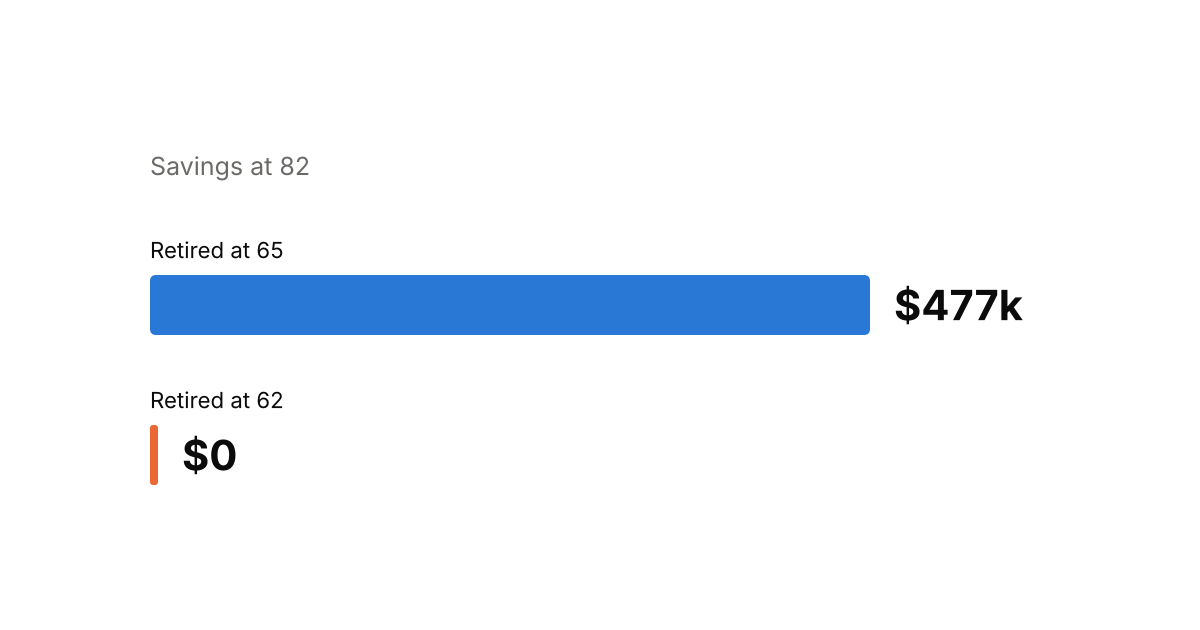
Three years early, half a million short
Mark and Julie had it all worked out. Both 62, mortgage gone, about $500,000 saved, and a plan to keep working until 65. Three more years of decent pay, three more years of putting money away, and then NZ Super would kick in and they’d be away.
Then Mark’s employer restructured. His role went, and at 62 the phone wasn’t exactly ringing. Around the same time Julie’s mum started needing more help, so Julie cut back her hours and then stopped altogether. Nobody made a bad decision here. Life just happened.
On paper they still had $500,000. It felt like plenty. So what did those three years actually cost them?
By 65 they had about $332,000 instead of the $625,000 they’d been counting on. Their money now runs out at around 82. If they’d made it to 65 as planned, they’d still have had $376,000 left at 90 and the money would have lasted past 100.
That’s a $294,000 hole by 65, and it keeps getting deeper. By the time their money runs out at 82, they’re nearly $500,000 behind where they would have been.
Three years of lost work. Half a million dollars and almost twenty years of retirement funding gone.
Mark and Julie are made up, but their story is a really common one.
This happens far more than people think
Most people I talk to have a number in their head for when they’ll finish work. Often it’s 65, because that’s when Super starts and it feels like the finish line. Other times it is sooner. The research says around half of us won’t get to choose.
The longest running survey on this is the US Retirement Confidence Survey, which has been asking retirees about it since the 1990s. In 2026, 46% of retirees said they stopped work earlier than they’d planned. Only 6% worked longer than planned. That number has barely moved in 30 years. It was 48% back in 1996 and hit 51% in 2008.
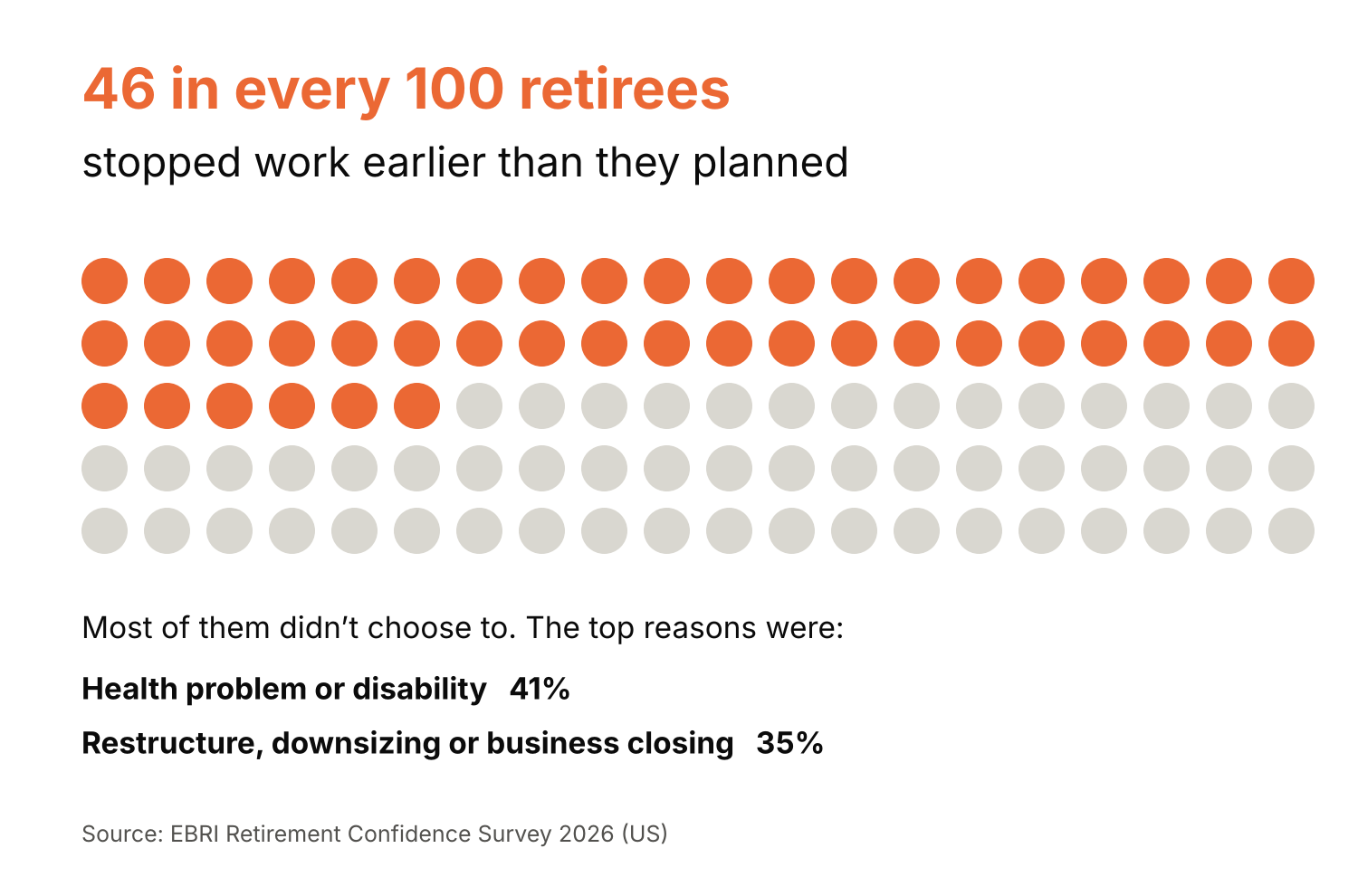
Most of those early finishes weren’t by choice. The biggest reason people gave in 2026 was a health problem or disability, at 41%. Restructures, downsizing and businesses closing accounted for another 35%. Other smaller reasons include stopping to care for a partner or parent, and people whose skills no longer matched what their job needed.
A separate 2024 survey from the Society of Actuaries put the share of people retiring earlier than expected even higher, at 59%.
What I find most telling is the gap between what workers expect and what actually happens. When Allianz asked people who were still working why they might retire early, they picked the nice reasons. More time with family, being financially ready ahead of schedule, less stress. When they asked people who had actually retired early, the top answers were health issues and losing their job.
Long, stable careers don’t protect you either. ProPublica and the Urban Institute dug into the US Health and Retirement Study and found 56% of older workers in long term, full time jobs were laid off or pushed out at least once on their way to retirement. Add in people who left because of their health or family and it gets close to two thirds. Only about one in ten of them ever got back to earning what they had before.
Most of this research is American. I haven’t been able to find a solid NZ figure, and I’d be surprised if we’re wildly different. People get sick here, companies restructure here, and parents need looking after no matter where you live.
Why three years does so much damage
Stopping early hits you in three ways.
1. Your contributions stop. For Mark and Julie, that’s $25,000 a year they were no longer putting away.
2. You start drawing down years earlier. Less money left invested means less growth for the rest of your life.
3. You’re paying for everything yourself. Before 65 there’s no Super, so your savings have to cover your full living costs. After 65, Super covers a big chunk and your savings only need to top up the gap.
That third one is the killer. Between 62 and 65, Mark and Julie needed $70,000 a year from their savings. From 65 they only need about $25,600 a year, because Super covers the rest. Each of those pre-Super years burns through savings almost three times faster than any year after it.
There’s an extra kicker in New Zealand. If most of your savings are in KiwiSaver, you generally can’t touch them until 65 unless you qualify for something like a serious illness or significant hardship withdrawal. Being forced out at 62 can leave you looking fine on paper with very little you can actually spend. My example assumes all their savings are accessible, so for a lot of people the real picture is worse.
The numbers
Here’s Mark and Julie side by side. Same savings, same spending, same returns. The only difference is when work stopped.
| Works to 65 | Pushed out at 62 | |
|---|---|---|
| Savings at 62 | $502,000 | $502,000 |
| Savings at 65 | $625,000 | $332,000 |
| Savings at 80 | $498,000 | $41,000 |
| Savings at 90 | $376,000 | Nothing left |
| Money runs out | Lasts past 100 | Around 82 |
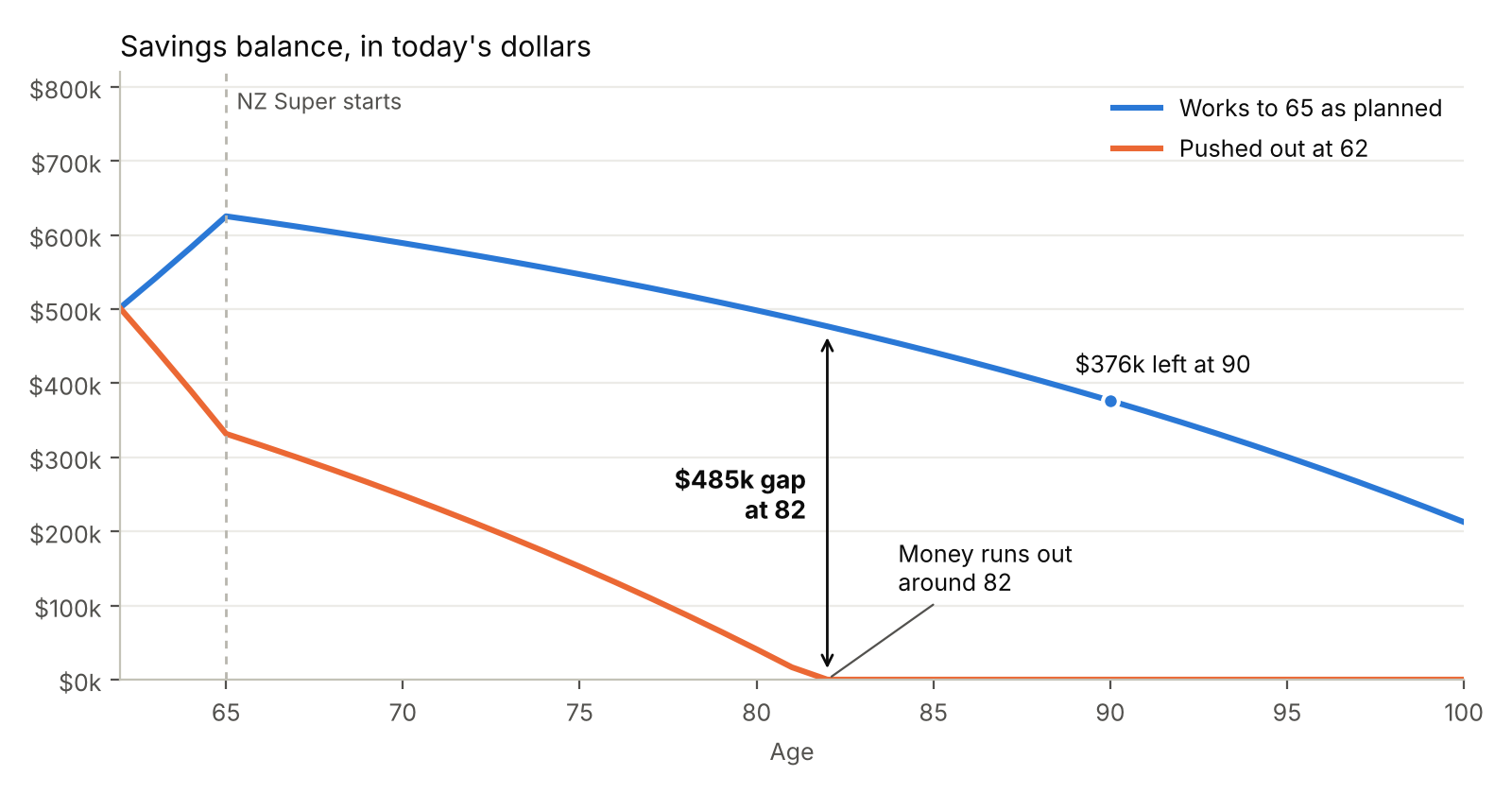
The financial impact of being forced to retire three years sooner than planned
The gap keeps growing
At 65, Mark and Julie are $294,000 behind. That would be bad enough, but the gap doesn’t stay there. The money they never got to keep would have carried on earning returns for the rest of their lives, so the hole gets deeper every year.
| Age | Works to 65 | Pushed out at 62 | Gap |
|---|---|---|---|
| 65 | $625,000 | $332,000 | $294,000 |
| 70 | $589,000 | $249,000 | $340,000 |
| 75 | $547,000 | $153,000 | $395,000 |
| 80 | $498,000 | $41,000 | $457,000 |
| 82 | $477,000 | Runs out | $485,000 |
| 90 | $376,000 | Nothing left | $615,000 |
By 82, when their savings run dry, they’re $485,000 behind. From there they’re living on NZ Super alone, which leaves them about $25,600 a year short of the $70,000 they planned to spend. By 90 they’ve gone without around $205,000 of spending, while the couple who worked to 65 still has $376,000 in the bank. Count the growth that missing money would have earned and the total difference is about $615,000.
So three years of lost work at 62 ends up costing close to half a million dollars by the time it really bites, and more than $600,000 if they live to 90.
Every year counts
Mark and Julie lost three years. Here’s how it plays out if you lose more or less than that. Everyone in this table is on the same savings path right up until the day they stop work.
| Stop work at | Savings at 65 | Money runs out |
|---|---|---|
| 65 (the plan) | $625,000 | Lasts past 100 |
| 64 | $530,000 | Around 98 |
| 63 | $433,000 | Around 89 |
| 62 | $332,000 | Around 82 |
| 61 | $228,000 | Around 76 |
| 60 | $121,000 | Around 71 |
Every year you lose before 65 takes roughly five to nine years off the back end. That’s the part people don’t see coming. A few years at the start of retirement decide whether the money lasts into your 90s or runs dry in your 70s.
What I’d do about it
My view is simple. Plan to finish work earlier than you hope to. If you want to work until 65, build a plan that still holds up if you stop at 60 or 62. If you get to keep working, great. Those extra years become a bonus that makes retirement more comfortable or gives you more to help the kids. If you don’t get them, you’re not scrambling.
A few practical ways to get there:
• Run your numbers with an earlier finish date. If your plan only works at 65, it’s a fragile plan.
• Build a bridge fund. Money outside KiwiSaver that you can actually get at, ideally enough to cover your living costs from your worst case finish date through to 65.
• Get the mortgage gone well before your planned finish date. Lower fixed costs make an early finish much more survivable.
• Check your insurance. Health is the number one reason people stop early, so it’s worth knowing what cover you have and what it would actually pay.
• Think about what part time work could look like. Even a small income between finishing up and 65 takes a lot of pressure off your savings.
Retirement is still something to look forward to. I just want your plan to still work when life doesn’t follow the script.
How I ran the numbers
For the number crunchers, here’s exactly what sits behind the example. I’ve kept it deliberately simple so you can check it or rebuild it in a spreadsheet.
Assumptions
• A couple, both the same age, who both stop working at the same time.
• $425,000 of savings at 60, growing to about $502,000 by 62 while they’re still working.
• Saving $25,000 a year while working.
• Spending $70,000 a year after tax, kept flat in today’s dollars for life.
• NZ Super of $44,410 a year from 65. That’s the after tax rate from 1 April 2026 for a couple who both qualify, on the M tax code, assumed to keep pace with inflation.
• A return of 3% a year after fees, tax and inflation.
• All figures in today’s dollars, so they show real buying power.
• Yearly steps. Each year the balance earns 3%, then contributions are added or spending is taken out at the end of the year.
• Savings are treated as fully accessible from 60, so the KiwiSaver lock is ignored.
• No redundancy payout, part time work, downsizing, inheritance or big one off costs.
• “Runs out” means the first year the balance can’t cover that year’s withdrawal.
How the gap builds
Both versions of Mark and Julie reach 62 with the same $502,000, so the whole difference comes from what happens over the next three years.
| Cause | Cost by 65 |
|---|---|
| Three years of $25,000 contributions that never went in, plus the growth they would have earned | $77,000 |
| Three years of $70,000 spending drawn early, plus the growth that money would have earned | $216,000 |
| Total difference at 65 | $294,000 |
Roughly three quarters of the damage comes from having to fund full living costs before Super starts. Losing the contributions is the smaller part.
From 65 onwards both couples get the same Super and take out the same $25,590 a year, so the only thing that changes is the growth on the money that’s missing. The $294,000 gap simply compounds at 3% a year. After 17 years, at 82, it’s $294,000 × 1.03¹⁷, which is about $485,000. After 25 years, at 90, it’s about $615,000.
Once Mark and Julie’s savings run out at 82, I’ve kept counting their shortfall as a negative balance. It represents the $25,590 a year of spending they have to go without, plus the growth that money would have earned. It’s the fairest way to compare the two couples like for like, but it does mean the figures after 82 are partly money in the bank and partly a lower standard of living.
Mark and Julie didn’t do anything wrong. They just built their plan around a date they didn’t get to keep. Build yours around an earlier one, and if you make it to 65, enjoy the extra cushion.
If you need help with your personal retirement planning, then get in touch today.
The information contained on this site is the opinion of the individual author(s) based on their personal opinions, observation, research, and years of experience. The information offered by this website is general education only and is not meant to be taken as individualised financial advice, legal advice, tax advice, or any other kind of advice. You can read more of my disclaimer here